Joe Sacco - The Once and Future Riot
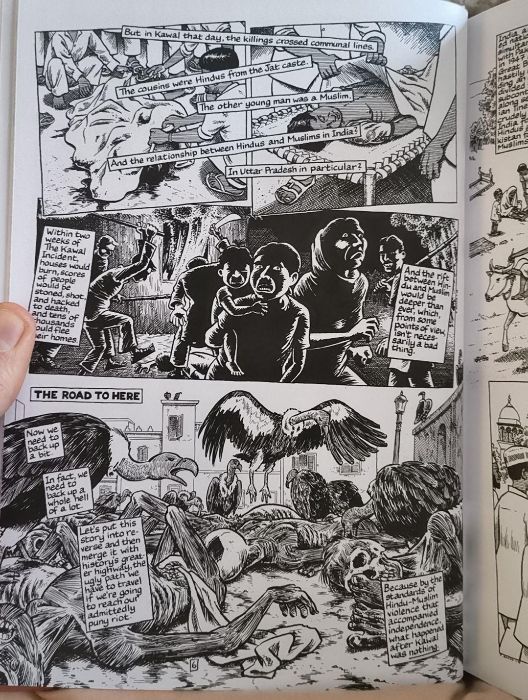
Joe Sacco's latest book, The Once and Future Riot, is journalism and anti-fascism in a bundle. Sacco goes to India to look into how Muslims and Hindus could once live together and are today separated by Hindutva, a fascist ideology that leads RSS, a paramilitary organisation, to ultimately serve BJP, the currently political party at the helm of India. The point of Hindutva and BJP is to annihilate Islam so they can cement ethno-fascist rule.
Sacco goes to Uttar Pradesh to untangle the start of what became the rule of BJP in 2014. This is all very well laid out by persons greater than myself, for example, Arundathi Roy in a speech that she gave in Stockholm, Sweden, in 2023.
The book is very well directed: Sacco is not only a very gifted storyteller but a person who is very adapt at digging for truth and fire, but extremely good at laying out panels, action, frustration, blood, nerve, and war on a page. At times, the book plays out like an action film, other times, focuses on tragedy as started by fascist men and deeply affecting women, mainly muslim women.
It's a deeply affecting, fast-paced, and well-told book. Sacco puts himself inside of the book and does not show off in the slightest. Instead, he paints pictures from the perspectives of many people by good-old gumshoe grafting: he asks to see purportedly burned-out houses, to meet with people who have seen atrocities with their own eyes, and questions people. It's always interesting to see how fascists try to combat truth with either lies or silence.
Lee Lai - Stone Fruit

Stone Fruit is the first book by Lee Lai, who has quickly become one of my favourite graphic novelists. This book, along with the published-in-2025 book Cannon, shows breadth, human understanding, and acute storytelling abilities. Wow.
The book follows mainly two lovers as they start delving both into themselves and into their flawed relationship. The book is trying, giving, and asked me what I think about my own life.
Another thing that made me like this book a lot: the perspectives from the child in the book. Wow, again. Lee seems unafraid and I can't wait to see what they'll make next.
John Berger - About Looking
Confrontation with a photographed moment of agony can mask a far more extensive and urgent confrontation. Usually the wars which we are shown are being fought directly or indirectly in "our" name. What we are shown horrifies us. The next step should be for us to confront our own lack of political freedom. In the political systems as they exist, we have no legal opportunity of effectively influencing the conduct of wars waged in our name. To realise this and to act accordingly is the only effective way of responding to what the photograph shows. Yet the double violence of the photographed moment actually works against this realisation. That is why they can be published with impunity.
This is a book of essays on a bunch of different subjects, mostly painters and photographers, also on photography and everything that John Berger felt.
In 1972, Berger made a TV series on imagery and how it can be interpreted. This essay collection is worth reading, even though I must confess that I haven't seen paintings by most of the people he wrote about in the book.
However, it's easy to dig into his words and get, well, kind of ensnared. The portraits aren't really the thing; the thoughts around the different subjects are, at least to myself, the best thing about the book.
Berger has clearly thought a lot about many of the things that he saw, and puts most of it into perspective over time, contrasts works with those by other creators, in other times, and in himself.
Sometimes the book felt a little like wanking and writing, but nearly all of the time, but that's probably down to myself being too hyperkinetic or being unable to deeply dig into works like Berger does; not knowing all of his references made me feel a bit out-of-touch.
Denis Johnson - Jesus' Son
I've heard so many glowing stories about Jesus' Son, a short-story collection, for a long time. I'm one of those persons who, when they hear too much great stuff about something, they think later.
Right now, around a tenth into the book, I wish I weren't that type of person.
I wish I'd dug into this book earlier. But here I am, and it's definitely time to bow down. I've read one story but it made me feel like I came home. Damn. It's that good.
Here's the start of the first short story, Car Crash While Hitchhiking:
A salesman who shared his liquor and steered while sleeping...A Cherokee filled with bourbon... A VW no more than a bubble of hashish fumes, captained by a college student...
And a family from Marshalltown who headonned and killed forever a man driving west out of Bethany, Missouri...
I recently read an article about Flagrant, Self-Destructive Gestures, a new biography on the author, Denis Johnson, and I want to read this, too.
Here's another paragraph from said story:
I was thrown against the back of their seat so hard that it broke. I commenced bouncing back and forth. A liquid which I knew right away was human blood flew around the car and rained down on my head. When it was over I was in the back seat again, just as I had been. I rose up and looked around. Our headlights had gone out. The radiator was hissing steadily. Beyond that, I didn't hear a thing. As far as I could tell, I was the only one conscious. As my eyes adjusted I saw that the baby was lying on its back beside me as if nothing had happened. Its eyes were open and it was feeling its cheeks with its little hands.
Robert Macfarlane - Underland
I've read Macfarlane's Underland, a spelunking book through a bunch of different places, including the mind.
Macfarlane writes in an illuminating way, one that puts places inside of my head, where they become real; they are real, they just feel unreal.
Where the River Elbe flows through the Czech Republic, summer water levels have recently dropped so far that ‘hunger stones’ have been uncovered – carved boulders used for centuries to commemorate droughts and warn of their consequences. One of the hunger stones bears the inscription ‘Wenn du mich siehst, dann weine’: ‘If you see me, weep.’
From the descriptive and mind-blowing to the creepily claustrophobic:
Moss, a tall and slim young man, was given the lead. An elektron caving ladder was dropped down the shaft, and Moss lowered himself into it. The shaft remained near vertical for around fifteen feet, then shallowed and twisted before making a sharp elbow-bend back to the vertical. With some difficulty, Moss negotiated the elbow-bend and descended the subsequent section – only to discover that the shaft then became choked with boulders. It had deaded out. He could feel the boulders shifting beneath his feet, but there seemed no further possibility of descent. So he began to re-ascend. Just below the elbow-bend Moss lost his footing on the ladder, slipped down a little – and found himself wedged. He could not bend his knees to regain purchase on the rungs of the ladder, which were anyway greasy with mud. His arms were pinned close to his body by the sides of the shaft, and his hands scrabbled vainly for grip on the slick limestone. The ladder seemed also to have shifted across the space of the shaft, perhaps dragged by the movement of the boulders at the shaft’s base, further blocking upwards progress. The fissure had him fast – and with each movement he made, his entrapment tightened a fraction. ‘I say,’ he called up to his friends in the chamber, some forty feet above him, ‘I’m stuck. I can’t budge an inch.’
We follow Macfarlane deep under Paris, high up in mountains, see how Walter Benjamin committed suicide to how some underground caves contain isolated weather systems. The book is a monumental undertaking, and only a systematic and grand writer could pull this off well without succumbing to repetition and trite description. Reminiscent of what David Grann does in his inner and outer trips, yet smaller, and simultaneously wider; its like discovering universes where you can go as you're doing yoga at home while breaking through the you barrier