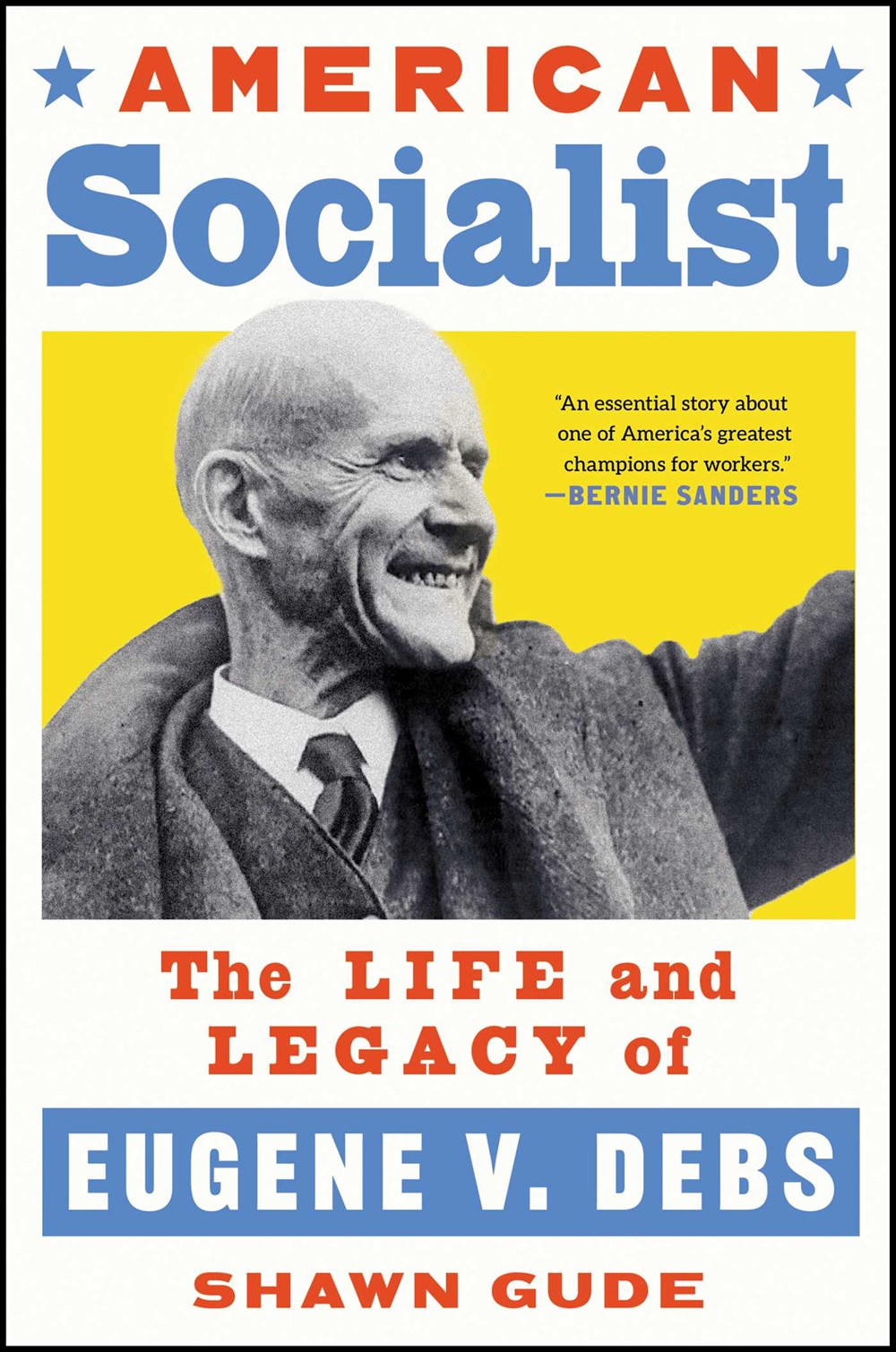
Shawn Gude has recently had a book published: American Socialist: the Life and Legacy of Eugene V. Debs. I recently read the book: it's a clearly and exhilarating book about Debs, a person who is often cited as a working-person's hero by people like Noam Chomsky and Bernie Sanders; he was lauded by contemporaries like W. E. B. Du Bois and was one of the reasons for why socialist unions and laws for worker rights increased substantially at the start of the 1900s.
To me, Debs is a clear example of how constant struggle is required to change things, especially where one or a handful of people hold extreme wealth while many people who labour under their jackboot starve.
The rest of this post consists of quotes from the book, which I recommend with all of my heart.
Always on the road, speaking in packed labor halls and auditoriums crammed with men and women still carrying the scent of a twelve-hour day, Debs had transformed into a labor agitator whom workers regarded as one of their own. Oklahoma tenant farmers would load up their wagons and travel hundreds of miles to see his almost religious orations up close; immigrant garment workers in Chicago thrilled at this native son who brandished the red banner with such zeal. He convinced untold numbers of ordinary Americans that by banding together, they could unseat the corporate tycoons who bought elections to create a freer, more democratic society. At one point, some 1,200 Socialists held elected office across the country, including 80 mayors in 36 states, and led several major unions too. When Debs’s agitation landed him behind bars, he received a million votes for president while in prison.
Pullman himself attended the second meeting to deliver his response: sorry, no chance. To remain competitive amid the depression, the company had to shrink labor costs. He had done all he could for his workers: he’d given them a place to live, a place to relax, had treated them, he said, as his “children.” His children. The next day, when three members of the grievance committee were fired, workers saw red. On the morning of May 11, Eugene Debs received an urgent telegram in Terre Haute: the Pullman workers were on strike.
For years, Debs had been moving left. He would continue to do so until the day he died. But the Pullman Strike was his baptism, the waters out of which a new Debs was born. It was like a religious experience, this plunge into the pool of mass solidarity. He was now, and would forever be, a radical working-class agitator.
He said: “I hear much now about the sacred rights of property…. What about the rights of human beings?” He said: “the miner”—in debt to the company—“is an abject slave, with no hope for him except through the back door of suicide.” “Sensation,” the newspaper stenographer recorded as the audience’s reaction.
He didn’t use his charisma to inspire mindless devotion and was insulted when critics suggested he did. His goal was to educate workers about the mechanisms of the capitalist system and put steel in their backs so they might confront it themselves. Capitalism had treated them as dim-witted “hands,” had degraded them so thoroughly they questioned their own humanity. Debs insisted workers view themselves as thinking, breathing authors of history. “The true leader uses all his power, not to rule others,” he said at one point, “but to impart the power and intelligence to them to rule themselves.” “My ideal,” he remarked elsewhere, “is a thinker in overalls.”
Then came the glib conclusion: “There is no ‘Negro problem,’ ” Debs argued, “apart from the general labor problem. The Negro is not one whit worse off than thousands of white slaves who throng the same labor market to sell their labor-power to the same industrial masters.” Not one whit worse off. And yet, for progressive Black newspapers, Debs’s egalitarianism outweighed his analytical blind spots. “DEBS RIGHT!” The Cleveland Gazette cheered from its front page, while the Boston Guardian likewise approved of Debs’s response. Debs’s criticisms of Washington were not unique. George Washington Woodbey, the leading Black socialist of the decade, condemned the educator in similar terms. In a speech in Los Angeles, Woodbey thrashed Washington for being “a good servant of capitalism by educating other servants for capitalism.” Socialism was “the only solution to the race problem” as far as Woodbey was concerned, for capitalism was “wage slavery.”
Debs rightly grasped that Progressives’ reform project could be absorbed without fundamentally changing American politics. Corporate leaders might be setting up philanthropic foundations—some still with us today, including Rockefeller and Russell Sage—but wealth inequality just continued to climb. The top 1 percent now owned 47 percent of the country’s wealth—higher even than thirty years earlier—while the bottom 50 percent settled for a measly 2 percent. Whereas unions had become reasonably accepted in peer countries, in the US—ostensibly the world’s most democratic nation—police (or troops) were significantly more likely to arrest, injure, and kill strikers. That’s what Debs wanted to upend. He wanted an empowered working class, not a more enlightened business class.
And he rejected the racial hierarchy that many Progressives subscribed to—including the candidate so often compared to him. In the infamous 1906 Brownsville Affair, then-president Roosevelt had dishonorably discharged 167 Black soldiers for their alleged involvement in the shooting of a white bartender and police officer. (African Americans protested the rush to judgment, and the men were decades later exonerated.) The same year, Roosevelt wrote that he had no problem excluding the “average Negro” from voting rights and later remarked that Reconstruction had shown “the perfectly flat failure of negro suffrage in the South.”
Debs was different. He continued to support political equality for all and occasionally jumped into the civil rights fray. In 1911, he joined a public campaign to save a Black Arkansas teenager named Earl Gilchrist from the death penalty, writing, “This proletarian lad, a mere child, without a friend, the victim of prejudice and hate on account of his color, must be saved from the gallows.” The Pioneer Press, a Black West Virginia newspaper, singled out Debs’s contribution to the successful effort to spare Gilchrist’s life. Looking at the four major candidates in the 1912 election, W. E. B. Du Bois judged Debs the only one who “by word and deed, stands squarely on a platform of human rights regardless of race or class.” While he ultimately endorsed Woodrow Wilson, Du Bois wrote that “if it lay in our power to make [Debs] President of the United States we would do so.”
Most provocatively, Debs turned the movie’s treatment of rape—so vivid in racist paranoias of the time—on its head. We should be worried, he said, about quite the opposite: the white fiend and the Black victim. “There are four million mulattos in this country,” he pointed out. “If the black people today could tell their story… it would be replete with scenes infinitely more cruel and damning than those based upon Dixon’s novel and flashed upon the screen to conceal the white man’s crimes behind the Negro’s misfortune.” Debs’s letter ended with an exhortation for Black people to organize, free of white paternalism. “The progress they have made is mainly due to themselves,” he declared. “They owe little to the white race as a whole, save their exploitation and degradation.” The letters came pouring in.
Around the same time, Debs published his lengthiest article on the relationship between Black freedom and socialism, portions of which were widely republished in the socialist press. Part analysis, part moral condemnation, part exhortation, the article showed Debs’s understanding had deepened since his days of saying Black workers were “not one whit worse off” than white ones. Debs quoted heavily from Du Bois, whose recent article in the same publication, The Intercollegiate Socialist, had indicted American society (including, in Du Bois’s telling, most Socialists) for their “conspiracy of silence” around the “continual injustice toward one-tenth of its own citizenship.” Debs praised Du Bois for his candor. He looked inside the ranks of his own movement and confessed he found it wanting. The American Federation of Labor: guilty of fueling the recent “barbarous” East St. Louis Massacre—one of the worst race riots of the early twentieth century, with white mobs killing at least forty African Americans (likely many more) and forcing some six thousand to flee their homes. AFL leaders had stirred up hatred against the “undesirable Negroes” migrating to this industrial city who, because the AFL excluded them, took jobs as replacement workers during strikes. “Even among Socialists,” Debs confessed, “the negro question is treated with a timidity bordering on cowardice which contrasts painfully with the principles of freedom and equality proclaimed as cardinal in their movement.” He got personal: The negro is my brother. The color of his skin is no more to me than the color of his hair or eyes. He is human and that is enough. I refuse any advantage over him and I spurn any right denied him, and this must be the attitude of the Socialist movement if it is to win the negro to its standard and prove itself worthy of his confidence and support.
And yet even as late as 1916, the premise of US entry into the war was controversial. Woodrow Wilson won reelection that November running as a peace candidate. That changed the following April, when Congress approved Wilson’s declaration of war. The US entered the conflict on the side of the Allies, then led by Britain, Russia, and France. Wilson explained his change of heart by insisting the US was waging a war to “make the world safe for democracy,” safe from German autocracy. Financial considerations were arguably more important. “By April 1917,” one historian reports, “American bankers, led by J. P. Morgan and Company, had lent Allied countries more than $2 billion, all of which would be lost should Germany win the war. Losses of this magnitude would play havoc with American banks and, in turn, the entire economy.”
Eugene Debs was a radical American prophet—a transcendent figure, almost otherworldly in his bravery and resolve, yet as made up of blood and marrow as the millions he sought to rouse to action. He was a man who, in the words of that Polish-speaking worker in Chicago, “talks to us with his hands, out of his heart, and we all understood everything he said.” But it is not Debs’s life but his radical democratic spirit that is his true legacy. Wondering what he would say about this or that modern-day dilemma is a fool’s errand, yet we can rest assured Debs would insist on one thing: injustice won’t be stamped out by top-down reformers telling us to trust that they have our best intentions at heart or well-heeled centrists trying to convince us we all need to get along and just tweak around the edges or right-wing populists scapegoating everyone except the actually powerful. Much less the billionaires who inform us that anything but their continued rule would be catastrophic.
Working-class people will have to win the world—together—that humanity deserves.