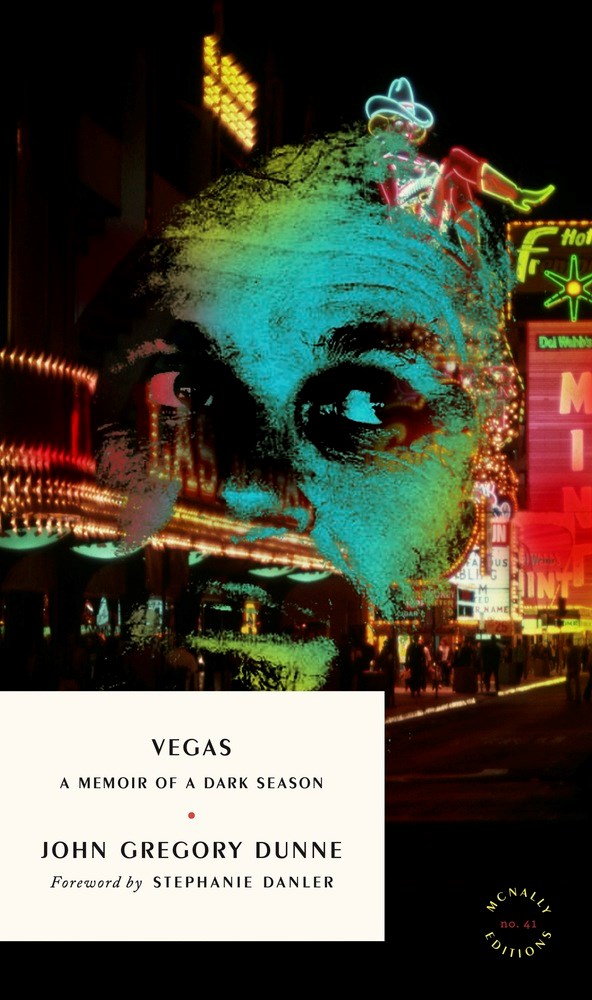
John Gregory Dunne was married with Joan Didion. In 1973, he'd had enough of life, of his marriage, of more things; he left his wife and their child and moved to Las Vegas. As he left, he didn't know he was going to stay there for a year. This experience turned into a book: Vegas: A Memoir of a Dark Season.
I am always being told things like that on first meeting, being told by strange women that they have cancer of the uterus, by men on airplanes that they have a colored mistress in St. Louis. Never black, never Negro, always "colored." I have never learned how to react, never comprehended why I am selected for these intimacies. Perhaps it is a penance for the deaf ear I turn to the problems of friends. I cannot bear to listen to why they are leaving their wives or how they are treating their alcoholism. "Really," I say to these strangers with uterine malignancies, or "I see." I never do see.
The language is straight, neat, short. At first, I was reminded of a more erudite and far less wry version of Hunter S. Thompson's writing. Dunne is more elegant, more plain, which lets the reader dig more into the psyche of the characters; or, rather, the persons that Dunne met.
This is autobiography. Las Vegas in 1973 seems to have been a seedy place, much as any place you'll go and spend it seedily.
Soft shoulders. If ever there seemed a perfect metaphor for my life that season, that was it.
A little more than a year ago, recorded conversations between Didion and her psychiatrists were released in book form, Notes to John. I'm not sure if these were ever intended by Didion to be made available to the general public, but here we are. I've not read them.
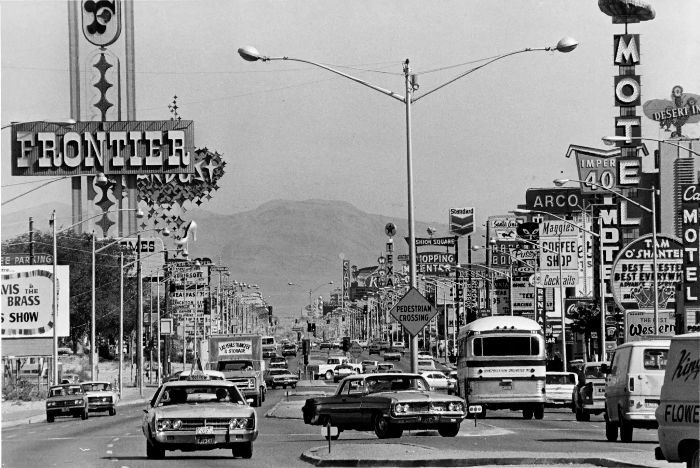
I drove some more. West on Sahara Boulevard, past the Strip, past the Be-Jak ranch, until the road just petered out in the desert. A couple of rattlesnakes sunned themselves by a sign that said: "Pavement Ends. Road Closed. Travel At Own Risk." The sign was pockmarked with bullet holes; the time and the temperature were still plainly visible in the Sahara Tower. The side of the road out there on West Sahara Boulevard resembled the trail of an army in full retreat. Carcasses of cars, refrigerators, propane heaters, furniture with the stuffing ripped out, a dump that was not even an official dump. Just a place in the desert to dump the leavings of a lifetime, out past the BeJak ranch before the pavement ended. Tires, old radios, television sets with no picture tubes, stoves, washing machines, bicycles, ironing boards, supermarket carts, air-conditioning units. Why here? Why did so many people travel out here past the Be-Jak ranch to junk their belongings? I could not find an answer, but today, years later, that stretch of highway out on the edge of the desert seems a more vivid image of Vegas than the lights of the Strip that even then were struggling against the summer twilight.
...
In her five years in Vegas, Artha had kept the following statistics. She had turned 1,203 tricks with 1,076 different johns. Ninety-seven tricks had been unable to get an erection, 214 came before penetration. She had engaged in anal intercourse eighty-eight times and fellatio 863 times. She had had thirteen professional lesbian contacts and three nonprofessional, and had been hired for "multiples," or group sex, fifty-four times. She had been whipped professionally eleven times and in turn had strapped tricks with a belt twenty-three times and with a horsewhip once. The masochists generally had preferred to get whipped around the genitals, the sadists to whip her buttocks. One client had paid her three hundred dollars to clip off her pubic hair, which he then put in a Mason jar; she never saw him again. She had been defecated on six times, urinated on thirteen times; she on her part had defecated on twelve tricks and urinated on twenty-two. Her vagina had been successfully penetrated by penises, dildos, bottles, bananas, frankfurters, candles and vibrators, and unsuccessfully by a pop-top can of Fresca.
One of Dunne's strengths was his ability to turn what could be shocking and used shockingly—what people like Thompson and Bret Easton Ellis did with nearly every breath of all of their oeuvre—as something deeply human. Most of what he wrote about sex, including the lechery of men, is very well placed on display for people to read about. Imagine Michel de Montaigne in deep crisis in Las Vegas, a few centuries after his time. There are few excuses made for the people in this book nor is there condemnation, other than that which is diligently observed by Dunne, the condemnation by other people than himself. This book contains no baleful descriptions—other than that of Richard Nixon—and it's good to read; I often felt like I was listening to inner conversations as though Dunne had cherry-picked the mundane and yet otherworldly. Some conversations appear from another planet, which could, as with most conversations, have occurred a few meters away from oneself, from one's self's outer wall, from one's experience, from one's ability to observe.
Max Callimanopulos has written a good and interesting book review of the reissued version of Vegas. I recommend reading Joan Didion's Slouching Towards Bethlehem. It's a form of reporting of its own, in very good ways; Didion feels like a suave observer who was keen to write, but not for the sake of writing, money, nor fame; she was cool. She was very good.