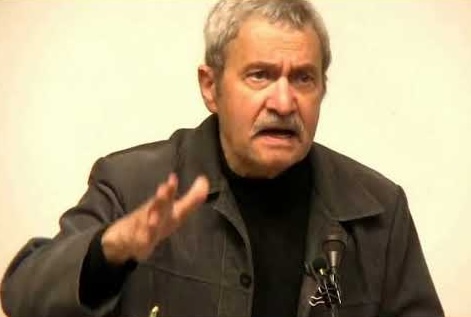
This is the start of a talk that Michael Parenti held in the University of Colorado in 1984. The introduction by David Barsamian was created in 2026.
David Barsamian
Michael Parenti was a leading independent political analyst, scholar and author. Cornell West called him a towering prophetic voice. He taught at major colleges and universities in the United States and abroad. He's the author of numerous books, including Democracy for the Few, Power and the Powerless and Against Empire. He passed away on January 24th at the age of 92.
Michael Parenti
I want to talk about capitalism. I think maybe it's time we do. It's a remarkable thing that you can take courses in political science and study institutions and policies and all. And never once has it mentioned that we live in a capitalist system. Now, I maintain that it's time we talk about that subject because capitalism is a system which spins off enormous imperatives which prefigure much of political life and limit it. Ours is a capitalist system. What that means is that the land, the labor, the resources, the capital, the technology, all these things are used for the purpose of accumulating capital.
The goal of capitalism is not to create jobs. In fact, capitalists will eliminate jobs if they can. It cuts labor costs. Nor is the purpose of capitalism to build communities. Capitalism will build or destroy communities as investment opportunities dictate. Nor is it the purpose to create a better life and a better environment for the generations yet to come.
Capitalism, corporations, will use the environment as a septic tank if it serves their profit purposes and they won't even help the generation that's struggling with it right now, let alone the ones to come. Nor is the purpose of capitalism to create efficiency and avoid waste because capitalism constantly pours its inefficiencies and diseconomies onto the public and into the public realm in the form of unemployment, injuries, unsafe products, pollution, things of that sort.
No, ladies and gentlemen, capitalism has only one goal and that's to make money for the capitalist. Karl Marx was right in Volume One of Kapital, that's what it's about. [...] Nor is it because the capitalist is evil or venal; individual capitalist are nice guys...some of them. It is the first law of capitalism which is that you must make a profit while you go out of business. That's what it's about. It would be true for you too, even if you went in with all the heartfelt desires to help the public, help your workers do this and do that and so forth, if you did those things, you go out of business. If you decide not to foreclose on your tenants or on the notes you hold, then you'll lose them. If they go to a good bank that feels like you and they won't foreclose and throw the people out, then that good bank—there ain't no such bank—that bank will fail and then it'llb e picked up by another bank which will know what to do and will understand that the name of the game is capitalism.
The function is to accumulate capital. That is the essence, the raison dêtre, the driving force in this society.
Capitalism has no loyalty to nation or to flag or to democracy or for that matter to autocracy or to God or to atheism or to any of those isms or any of those things; [it] has no loyalty to family. There's no social force in human history to compare to capitalism when it comes to the destruction of traditional values, the gemeinshaft values of homegrown rural and city life, the extended family, the clan and now even the nuclear family. It pounds away at things, as Marx says, and it recreates everything in its own image.
It has no loyalty to anything but itself. It is a remarkably rational system. That's what it's there for. It has no sentiment in it. It is imperative. All things, all people, all commodities, all values are reduced to instrumental objects to serve this end purpose which is to make money in order to invest it to make more money to invest it to make more money to invest it to make more money. As Marx said, it's money with money. The capitalist produces commodities and services which then give him more money.

The function is to accumulate capital, accumulate, accumulate, accumulate, as Mark said, driving on endlessly. It is not to make automobiles, it's not to make clothing, it's to make money. If the capitalist can make bad clothing and cheap clothing that'll make him more money,he'll do it that way. But don't take my word for it. Let's take David Roderick's word for it. He's head of US Steel Corporation. He said, 'US Steel is not in the business of making steel. It's in the business of making profits.'1'
Take the word of Henry Ford II whose dedication to capitalism is above suspicion. Several years ago, when he was before the Ribicoff Committee on Automobile Safety, more than seven, more like 15 years2 ago, and why are automobiles so unsafe? Ribicoff was saying, what's going on, Ford finally turned around and said, 'Look, Senator, Ford Motor Company isn't in the safety business.' He went better than Roderick. He made it more accurate because 'capital, the function capital is not to make profits.' He said it correctly. He said Ford Motor Company is in the business of making the highest possible profits for its stockholders. That's the crucial point.
Remember, it's all relative. If you've got your capital in here and you're only getting an 8% return, you yank it out and you put it there even if you leave a community destitute where you can get 15%. So you must make as much as you can. Now what dictates the allocation of these resources? What dictates how the land, the labor, and the capital and the technology of our society will be used is this imperative and not social need or human need. If I'm a shoe manufacturer and you're all barefoot, that is of extreme indifference to me. I couldn't care less. You may need shoes but I don't give you shoes because I'm not in the business of giving them to you.
Your need does not dictate production and investment. It is your buying power and that we call buying power plus want equals market. Now if you need shoes or may just want them, you may have 20 pairs home already, then I become interested. And nor can I do it any other way because I'm not in the business of philanthropy. I'm not in the business of feeding the poor. When the Citizens Committee on Hunger, a malnutrition in America went to US Food Corporation and said what are you doing about the fact that 12 million Americans in this country do not have enough to eat. US Food said if we saw the opportunity for a profitable return on investment, we move into that area and the Citizens Committee wasn't dignity. But the Citizens Committee was wrong and US Food was right. One of those two groups understood what the system was about and it wasn't the US and it wasn't the Citizens Committee. It was the capitalist. There are only two groups in this country who understand what that system is about and it's the capitalist and the Marxist. They both understand what it's about. And I agree with everything the capitalists say about how they operate. Not then all the tinsel and all the justification. I ideology they put on it on top of it. So things which have no profit but are a great social value can become totally neglected or even abused by the system. Things like the environment, human life, human health. Things which have little social value but great profit will attract great investment like chintzy cars with a lot of chrome on them and such.
Now, ladies and gentlemen, we've uncovered a mystery. We've uncovered the mystery that has plagued liberals so long which is and conservative critics of government too who profess to know the answer to that. Which is why are we unable to solve our social problems, unemployment, environmental devastation, the decay of the cities, inadequate healthcare. The mystery is solved. We cannot solve these problems because that isn't what our land, labor and resources are dedicated to. It's dedicated to something else. It's the end of the mystery. That changes our perception of it. Our social problems therefore, if my analysis correct so far, if I brought you along, this far manipulating you, you know, the way we read to, right?If I brought you along so far, then the very definition of social problem changes. Heretofore we thought of these problems as irrational spin-offs from a basically rational system as aberrations. What I would argue now is that these problems are the rational outcomes of a basically irrational system. Pollution is rational. It's correct. It makes sense. It's correct for good-year tire company to go into Connecticut and build on the MillRiver of factory and then dump its raw chemical industrial effusion into the Mill River, which took nature 100 billion years to create, which is used for recreation, for drinking water, for fishing, and destroy it and turn it into an open sewer. It's rational to do that because they cut their production costs and they increase their profits, which is their essence, the capital accumulation process. That's rational. It's correct. It's not correct from a human point of view. It's not correct from social values, but as I pointed out, capitalism has nothing to do with those social values. And when pressed on that, they will tell you, when you say you've polluted the environment, are you going to clean it up and say, it's too big a problem for us. They're big enough to dirty it. They're not big enough to clean it up. And that's correct too because when they dirty it, they increase their margins of profits. When they clean it up, they would go broke. And they're not in the business of philanthropy of doing anything that doesn't bring a profit. And we learn too that military waste is rational and correct. There is no such thing as waste on the capitalism if it's bringing in a profit. It's wasteful to see two workers standing idly for 10 minutes. It's wasteful to produce a product which doesn't sell as highly as you want. But it's not wasteful to have two contracts of a billion dollars each to build almost identical fighter planes, one from the Navy, one from the Air Force. That's not wasteful. That's wonderful. That's twice as much business. That's twice as much profit.
-
https://larouchepub.com/eiw/public/1977/eirv04n50-19771213/eirv04n50-19771213_016-us_steel_corp_we_make_profits_no.pdf ↩
-
This speech was in 1984, so the hearing was around 1969, according to Parenti. On the same note, from this article: 'In 1956, the Ford Motor Company had marketed a car including many safety features with the tag line: “Exclusive New Lifeguard Design.” When the model didn’t sell, the industry dropped “safety” from its sales pitches.' ↩