 Martin Lorentzon with a guitar, which feels fairly ironic, as his company works hard to decimate songwriter payouts and other horrid things. For more on Spotify, see my Spotify garden page.
A short while ago, Martin Lorentzon—Spotify co-founder and billionaire—posted the following complaint:
Zucmans and the Green Party's fundamental view is absurd. They make a problem out of the fact that we have successful entrepreneurs. Their view is extraordinarily damaging to Sweden.
The rest of this post is the reply from Gabriel Zucman, economist and Professor at Paris School of Economics, to what Lorentzon wrote.
Hello dear Spotify founder Martin Lorentzon.
There is nothing "absurd" about pointing out that Swedish billionaires like yourself pay a lower share of their income in taxes than ordinary Swedes. It is a fact.
But since you question our research on the regressivity of Sweden's tax system, allow me to explain the main conclusions of our work, the most comprehensive to date on this issue.
You recently published an op-ed laying out your arguments against the billionaire tax I support.
I'll come back to them.
But first, let's start with the problem such a tax is designed to solve: the regressivity of the tax system at the very top.
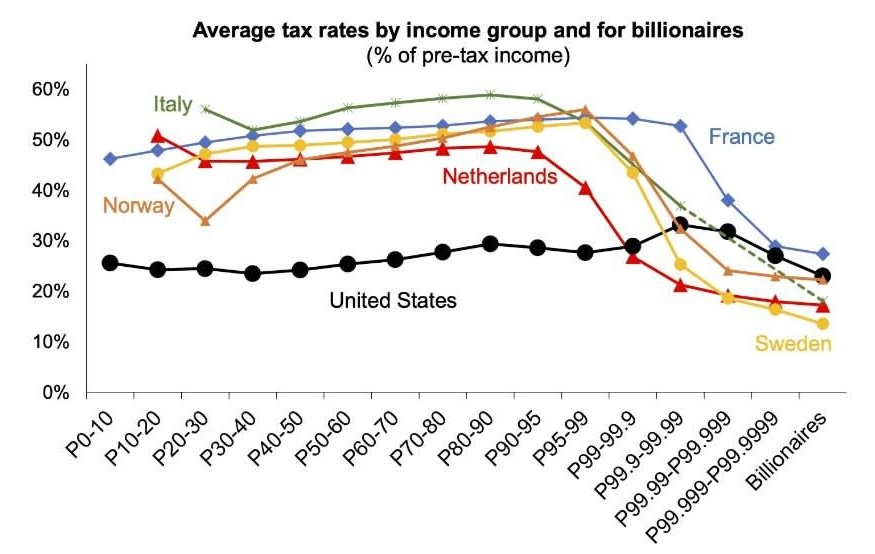
Recent studies conducted across the world show the same striking pattern: billionaires pay less tax, relative to their income, than the rest of the population.
Why?
In a nutshell, because they can easily report no or very little taxable personal income.
As a result, income tax—in principle the key pillar of tax fairness—vanishes among billionaires.
Through holding companies and other legal structures, the ultra-wealthy opt out of contributing their fair share to the common good.
That is a clear violation of the principle of equality before the law, one of the fundamental pillars of liberal democracy.
We recently investigated this question in Sweden and Norway with Marius Ring and David Seim.
[Niklas's comment: Ring is Assistant Professor in the Finance Department at the University of Texas at Austin and Faculty Research Fellow at the NBER; he is currently at Yale as Senior Lecturer and Senior Research Scientist in the Economics Department. David Seim is Professor of Economics at Stockholm University.]
We started with a simple hypothesis: if any countries succeeded in taxing billionaires effectively, surely it would be the Nordic countries.
To our surprise, we found the opposite.

Link to research paper in PDF form.
Billionaires pay particularly little tax due to the quasi-systematic use of personal holding companies.
And because the middle class pays a lot of tax in Sweden, the drop-off in effective tax rates is spectacular: from around 50% for the upper-middle class, all tax included, to only around 15-20% for billionaires.
Sweden thus has one of the most regressive tax systems at the very top that we observe anywhere in the world.

How is this possible?
The key mechanism is the personal holding company.
Instead of receiving income directly, subject to the individual income tax, ultra-wealthy individuals earn their income—mostly dividends, which can be in the billions of kronor—through personal holding companies, free from individual income tax.

For ordinary taxpayers, the basic principle is simple.
You earn a salary: it is taxed before you can consume or save it.
You earn self-employment income: it is taxed before you can consume or save it.
You receive pension income: it is taxed before you can consume or save it.
But for the ultra-wealthy, the rules are different. They earn billions in dividends: this income is not taxed and can be saved tax free.
As long as this income stays in their personal holding companies, it remains tax free.
Some pretend that this income earned in personal holding companies is not "real income".
This is incorrect and reflects a confusion between two fundamental economic notions: income and consumption.
This income is very real: it can be used to buy yachts, real estate, media companies, shares in companies, or to do some philanthropy - anything one might want to do at that level of wealth.
To sum up, here's the fundamental anomaly: for most people, the income tax taxes all income whether it is consumed or saved.
For the ultra-rich, only the fraction of income which is consumed is taxed. And this fraction is tiny, because one simply cannot consume billions every year.
Hence the very low tax rates of the super-rich, a tax avoidance that significantly reduces government revenue.

So let's talk now about your first objection to a billionaire wealth tax: "liquidity."
About 90% of billionaire wealth consists of shares in companies. But shares are financial assets.
A Spotify share worth €500 is not "virtual wealth." You can buy it for €500 today and sell it tomorrow. If its price has not changed, you get €500 back.
Elon Musk used to pretend his wealth was "virtual", until he bought Twitter for $44 billion, with very real consequences.
Your second argument is tax exile.
"Billionaires will leave if we tax them."
Some will - if leaving allows them to escape the tax.
But that is not a law of nature. It is a policy choice.
Sweden could keep taxing its superrich individuals after they leave for, say, 10 years after departure.
Then moving abroad for tax purposes largely ceases to solve the problem.
So no, Mr. Martin Lorentzon: there is nothing "absurd" about correcting the fundamental injustice at the heart of Sweden's tax system.
When billionaires pay lower effective tax rates than ordinary citizens, the tax system is failing at its most basic task.
It erodes the tax base. It erodes trust. And it is neither efficient nor fair.
The solution is to establish a simple principle: Extreme wealth must come with an unavoidable minimum tax contribution.
How?
Not by defining the minimum as a fraction of taxable income - the whole problem is that billionaires can arrange to report very little taxable income. Instead, use wealth, which is much harder to manipulate.
My proposal is straightforward.
Billionaires and centimillionaires should pay at least 2% of their wealth in taxes each year.
This is a minimum tax, not an additional 2% tax on everyone.
If you already pay taxes equal to 2% or more of your wealth, you owe nothing extra.
Only ultra-wealthy people who currently pay exceptionally little would owe more, bringing them up to the minimum.
And 2% was not picked out of a hat.
It is approximately the rate needed to eliminate the regressivity we observe at the very to - to stop billionaires paying lower effective rates than ordinary citizens.
Mr. Martin Lorentzon, I understand that the taxation of billionaires has become a major issue in Sweden's election campaign - and that you have responded by saying you would leave the country if a wealth tax were introduced.
But ordinary citizens have every right to ask why they should face higher tax rates than billionaires.
This question is not uniquely Swedish.
The same debate is taking place in France, the United Kingdom, California and elsewhere.
The details differ. The underlying principle does not:
A democracy cannot sustainably ask ordinary citizens to contribute a larger share of their income than the people with the greatest ability to pay.
And the idea of creating an unavoidable minimum tax based on wealth is gaining ground.
It has attracted broad public support, from political parties, trade unions, economists and Nobel laureates.
Why? Because the underlying principle is difficult to dispute: no billionaire should be able to live in their own parallel society, tax free.
So, Mr. Martin Lorentzon, you are of course entitled to oppose a billionaire minimum tax.
But calling it "absurd" does not make the underlying issue disappear.
Sooner or later, in Sweden like in other democracies, billionaires will have to pay their fair share.