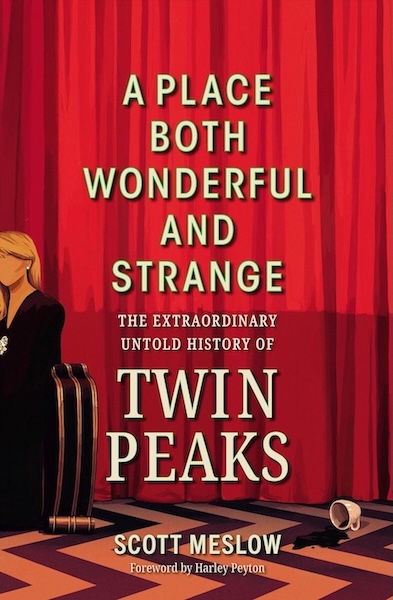
I'm a Twin Peaks fan, although I'd be rejected by true Twin Peaks fans. I've visited exactly one convention, never visited a single filming location, etc. However, I've read a few Twin Peaks books, including those by Mark Frost, one of the two creators of Twin Peaks, and a third in, I must say this book is by far the best one that I've read1.
Scott Meslow's new book A Place Both Wonderful and Strange: The Extraordinary Untold History of Twin Peaks is lovingly told and it also manages something extraordinary: it's not filled with bullshit and self-admiration. It's a very erudite trip through very tricksy territory. While Twin Peaks managed to be funny, fun, scary, and absolutely horrifying—not least due to how I think it handled child abuse better than any film or TV media I've ever seen—it's absolutely astounding in terms of being art.
Here are some loose excerpts from the book; each paragraph is separate. Buy the wonderful book!
“As we talked through all the elements, we started to place where they were on the map as he sketched them,” says Frost. “We didn’t have a name for the town, but we had these two mountains, White Tail and Blue Pine, on either side. And I said, ‘Well, why don’t we call it Twin Peaks?’ It hit us on the head like a two-by-four. We said, ‘Yeah, that works.’” For both writers, the town was becoming real. “We knew where everything was, and it helped us decide what mood each place had, and what could happen there,” said Lynch. “Then the characters just introduced themselves to us and walked into the story.”
Cooper has come to Twin Peaks to solve Laura Palmer’s (Sheryl Lee) murder. At the time the pilot was written, it was an inherently doomed mission; not even Lynch and Frost knew who had done it. “We didn’t want to solve it, at that point,” says Frost. “That was a clear decision on our part, creatively. We didn’t want to limit ourselves. And we felt if we locked it in too early, that’s exactly what we’d end up doing. [If we waited], something that might occur to us that’s even more interesting.”
Where the cocreators disagreed was whether the murder mystery would ever be resolved. “I felt that we would have to do it sooner or later,” says Frost. “David, in his kind of wonderful, Peter Pan sort of way, thought, Well, no, we don’t ever have to solve it. And I said, ‘Well, that’s not how television works. You have to give them something at some point, or they’re going to just drift away.’”
Crucially, Twin Peaks never feels judgmental of Laura, or her peers, who are almost constantly subjected to the dangers faced by any teenage girl who dares to exist in a hostile and violent world. That doesn’t excuse the physical and emotional violence Laura inflicts on others; it’s simply an acknowledgment of the cycle of abuse that began, if you take The Secret Diary of Laura Palmer as canon, in 1984, when Laura was twelve.
In her hands, it’s clear that Laura Palmer has survived abuse by becoming a masterful code-switcher. She can shift, apparently at will, between girlish and embittered, innocent and hardened. She’s full of pain and rage, but her feelings of isolation and self-loathing are so entrenched that she lashes out at Bobby, James, Harold Smith, and anyone else who tries to help her. When she learns the truth about the man who’s been abusing her, her horror is endless. From there, her downward spiral leads her, unwillingly and unfairly, in the only direction this story could conceivably go; Laura’s murder, inevitable from the moment Twin Peaks was conceived, is no less awful for being preordained in the story Lynch wanted to tell.
The trick, of course, was assembling the team who understood how Lynch worked. One key early hire was Duwayne Dunham, who Lynch brought on to edit the pilot. “David sent me the script for Twin Peaks and with a note saying, ‘They’re never going to air this thing, but they’re going to give us money to shoot it. So why don’t we just go up and have some fun and make a movie?’” says Dunham. Dunham, an assistant editor on all three installments of the original Star Wars trilogy, had first worked with Lynch as the editor of Blue Velvet, and the two had developed a natural trust and rapport rooted in the unusual amount of creative freedom Lynch had granted. “On Blue Velvet, I said to David one day, ‘How come you don’t ever give me any specific notes on how to do the scenes?’ says Dunham. “He said, ‘Because if I gave you notes, I would simply be telling you how I would do it. If I don’t tell you, you use your own instincts, you do it your way, and I might like your way better.’” Though no one would accuse Lynch of having anything but a singular directional vision, he was wise enough to know when he had found a collaborator talented enough to enhance a project. Decades later, he would hire Dunham once again to edit Twin Peaks: The Return.
Also reading for Truman was Ray Wise, who ended up with the role of Leland, the father of the murdered girl. “I got a phone call from my agent saying, ‘David wants you to play Leland Palmer,’” says Wise. “And I had to think. Leland Palmer? Wait a minute. I’ve got to go back and look at the script. So I’m looking at the script, and I see: ‘Leland Palmer finds out his daughter is dead, and he drops the phone and starts to cry.’ ‘Leland Palmer goes to the morgue to identify his daughter’s body, and he starts to cry.’ ‘He’s up in his daughter’s room, where the police are looking for her diary, and he starts to cry.’ I said, ‘All this guy does is cry.’” It was only after a little reflection that he concluded he might enjoy the work required to play a father contending with such an unfathomable loss in an interesting way. “That was going to be the challenge: to show different degrees of grief, and try to make each one very specific and different and, hopefully, interesting to the viewer,” says Wise.
The other, even stranger belated addition to the cast was Frank Silva, who was cast, on a whim, in what became the role of BOB, Twin Peaks’ all-purpose avatar of the evil that men do. It is a story no less remarkable for its familiarity among the Twin Peaks faithful. Silva, a set dresser, was moving furniture around in Laura Palmer’s bedroom. When a production assistant called out, “Don’t get locked in there, Frank!” an image flashed into Lynch’s head: Silva crouching menacingly at the foot of Laura’s bed. This is the kind of impulse that nearly any other director would have let pass. Lynch, as was his way, decided to shoot it, without any idea what it meant or if he’d use it. Later that day—shooting a scene in which Laura’s sleeping mother, Sarah, played by Grace Zabriskie, suddenly wakes up and screams—Lynch was warned by the camera operator that the shot was unusable because a crew member had been caught in the mirror behind her. It was, of course, Frank Silva, whose ghoulish reflection, while totally unplanned, made the final cut. Lynch’s burst of inspiration was so spontaneous that Silva hadn’t been through wardrobe; the blue denim jacket, which BOB wears through the rest of the series, is simply what Silva had pulled out of his closet and worn to work that morning.
-
Possible exception being Frost's second Twin Peaks book that was published just before the third season. ↩