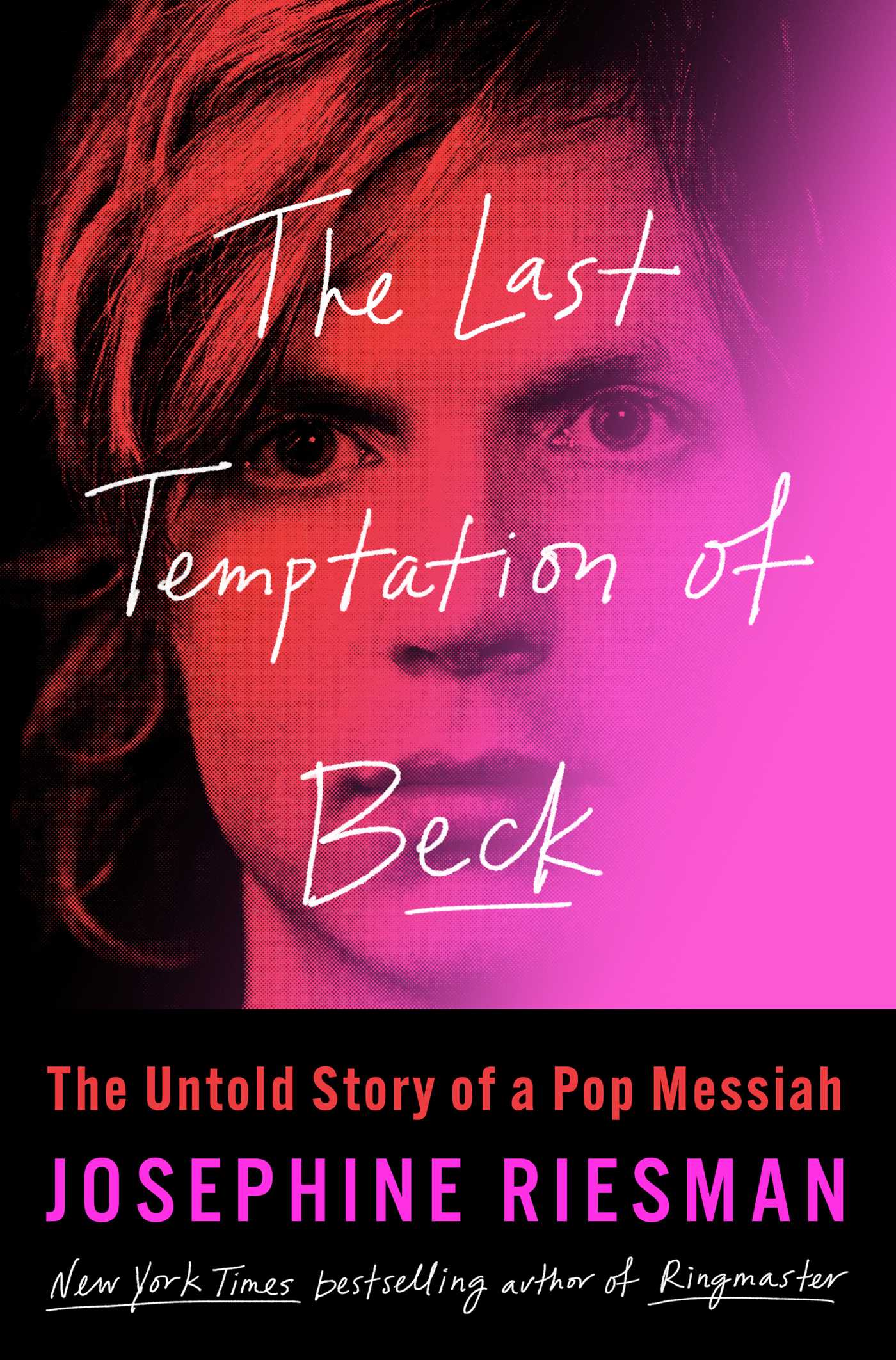
I've just finished reading The Last Temptation of Beck by Josephine Riesman. The book focuses on his change: from being a child of scientology parents into being a fully–fledged scientologist, from humble beginnings to a double suicide, from being young with a girlfriend to being older and leaving people behind because that the choice of scientologists, perhaps not Beck himself.
Where does the self die in lieu of an illusion?
Riesman digs into how Beck grew up, through a variety of sources, from his horrid break–up with Leigh Limon.
I recommend Riesman's article Losing Beck, which says a lot.
The following quotes are all from the book.
By late 1996, there was Beck Hansen, and there was “Beck.” “Beck” was an art piece, a Happening, a mobile performance installation made by the tireless work of four people. Of course, “Beck,” as a concept, was largely built on the music and voice of the man born Bek David Campbell: his stringy form and his deliberate misdirection in interviews, his alternating folksy shyness and funky bombast onstage. But “Beck” was also a product of Steve Hanft’s music videos, the shambolic, eerie, and often beautiful clips that defined Beck’s music in the MTV era. “Beck” was also fueled by the constant stream of obscure culture and elliptical inspiration Ross Harris provided for the star to devour and remix. In the liner notes for Odelay, Ross was credited as “the Wizard.” And then there was Leigh, Beck’s girlfriend of five years, who had defined Beck’s much-praised look. She combed vintage and thrift shops, scouring fashion history to put together outfits for Beck that were eclectic yet consistently cool. It wasn’t an easy target to hit, but Leigh’s sense of style was unerring. Under her curation, Beck became a fashion trendsetter. And Beck received her ideas with enthusiasm; he respected her as an artist. But now there was a new member of the creative team: David Campbell, Beck’s father, was back in the picture.
Whatever Leigh got paid for her work went directly into Beck’s bank account, which she had permission to draw from. She didn’t have her own. But she took a lot of pride in her part of Operation Beck. She was well aware that the man she was dating wasn’t the person the press and public saw—the version of Beck reporters got was edited at best, fictional at worst. There was a lot he left out of his life story. He never breathed a word about Scientology to journalists, for one thing. Early on in his relationship with Leigh, Beck had mentioned that he’d grown up in Scientology, but that he was out of the Church. She was fine with that. In the early years of their dating, they’d make fun of Scientology if it came up in conversation. The joking had died down since then, and Beck certainly never talked about his religious upbringing in public.
David Campbell was there, arranging and conducting an orchestra for the track “We Live Again.” Justin Meldal-Johnsen was there, playing a stand-up bass. Superstar producer of Radiohead’s OK Computer Nigel Godrich was behind the boards. But unlike with Odelay, Ross wasn’t there. Beck hadn’t invited him. There hadn’t even been a falling-out. That was what frustrated and confused Ross. Nothing had happened; he just suddenly fell out of the loop. Ross had sensed Beck gravitating away from him and Steve, toward Justin and David. Or maybe not toward them individually; maybe toward Scientology more broadly. Ever since meeting David backstage at Lollapalooza, Ross had suspected that Beck had familial connections to the Church, but Ross never, ever brought up the topic. To this day, Ross and Beck have never discussed Scientology. The fourteen-day recording session at Ocean Way eventually resulted in an album Beck called Mutations. It was an improbably beautiful collection of songs, with elements of space-age folk, chamber pop, and even Indian raga, all thrown together in a hurry.
Leigh liked David Campbell, but she remained deeply suspicious of all the other Church members. When Leigh confronted Beck about all the Scientologists who were now in their lives, he said he had no plans to rejoin the Church. But she didn’t feel reassured by how he said it. Leigh, he said, Scientology doesn’t make you a better or worse person. It just makes you more of who you are.
Leigh is working a late night on the Southlander set. Ross and Steve have hired her to do styling for the film and she’s been an enthusiastic member of the production team. Beck has been touring—she hasn’t seen him in weeks. He’s coming back tonight, flying in from Japan. Before she’s done with work on set, she gets a call from Beck. She picks up the phone. Come home, he says, sounding grave. I want to talk to you. Anxious, she tells Ross and Steve she has to go. She drives to the house in the Volvo Beck owns and lets her use. It’s dark when she reaches Silver Lake. The house is lit up inside. She lets herself in. A group of strangers are waiting for her in the living room. Some of them are in suits. Others are in uniforms that she recognizes from her limited knowledge of the Church: They’re Sea Org.
Beck is there, too. He’s not looking at her. One of the strangers steps forward. A blonde with a terse face and a dark suit. She informs Leigh that she is Beck’s legal representative and that she will be accompanying them to the dining room for a conversation. Terrified, Leigh follows them to the dining room. Beck turns to her. He seems changed. She’ll later tell friends that it was like looking at a cruel mask; while once she had fondly observed what she thought of as a charming insectoid alien, she now sees Anakin Skywalker becoming Darth Vader.
How could you, Beck says flatly. How could you do all of that.
She says she doesn’t know what he’s talking about. And Beck explodes. For long minutes, Leigh dissociates while Beck delivers a furious soliloquy about her alleged sexual profligacy and drug use, and how it’s been ruining his life. He says he’s done with her. They’re over. And he’d better not see her on the Southlander set. The blond lawyer’s expression hasn’t changed throughout the whole diatribe. Now she’s instructing Leigh to follow her to the table, where she’ll be signing some paperwork. Before Leigh can respond, the lawyer informs her that she won’t receive any of her possessions in the house unless she signs the papers. Beck leaves the room.
Leigh sits down and signs whatever is put in front of her, not reading any of it. The lawyer collects the papers and says that Leigh is now to leave the premises.
What about my stuff? Leigh asks.
We’ll contact you, the lawyer replies. Leigh is shuffled out of the house. Beck doesn’t reappear to say goodbye. The door shuts firmly behind her. She stands alone on the lawn. Without Beck, she is not just single—she has no job, she has no bank account, she has no house. And she certainly can’t get back in the car that Beck owns—that would now be theft. God, Leigh thinks suddenly, where will she even sleep tonight? (Beck did not respond to my requests for a comment on the breakup.)
Leigh wasn’t the only one who would be excised from Beck’s new life. Some time later, Ross got an email from Beck. In it, Beck told Ross that he’d “disconnected” from Steve. Ross recognized this as Scientology lingo meaning a total end of all contact. It seemed bizarre to Ross: Steve and Beck had just recently shot the video for Beck’s song “The Golden Age,” from his upcoming record. According to Steve, he and Beck had spent the shooting day together by the sea, goofing off and filming as the light glittered on the waves—a classic Steve and Beck day. And now, Beck was telling Ross that Steve was out of his life, forever. Period. Ross got the feeling that this was a warning: You could be next.
In the fall of 2002, Beck went on tour with legendary Oklahoma City art-rockers the Flaming Lips. They would open for him, then play with him as his band. Despite the promise of that combination, the tour turned out to be something of a disaster. Truck was at some of those shows, as were reporters, and they all saw firsthand how ill-suited this iteration of Beck was for collaborating with the Lips.
ven before the tour got on the road, things seemed off. Flaming Lips drummer Steven Drozd’s sister died unexpectedly by suicide, just before rehearsals were set to begin. Drozd left her Oklahoma funeral early to catch a plane so he’d make the first session. He arrived just in time. And then waited more than five hours for Beck to show up.
Beck was late to rehearsal the next day, too. And the next. Sometimes, he’d show up late and eat a meal prepared by a personal chef for two hours, sending back dishes that he found unsatisfactory. The Lips told him that if he couldn’t make rehearsals, he should just let them know in advance. But he wouldn’t.
In fact, Beck rarely dealt directly with the Lips, preferring to let people from his team deliver edicts. Initially, they were told they wouldn’t be able to perform their own songs; they would just be Beck’s backing band. They’d protested and won their own opening sets. They proposed that their final song every night be immediately and seamlessly followed by Beck’s first. Beck refused, and on tour, the break between the two sets often ran up to forty-five long min utes. Beck’s crew promised to haul the Lips’ gear, but reneged on the deal at the last minute, forcing the band to scramble to hire a crew of their own. There were other little cruelties. Drozd was recently drug-free, and chewed gum to stave off heroin cravings. Beck’s manager told him he couldn’t have gum onstage because it looked “unprofessional.”
“Note: Wayne Coyne, singer for the Flaming Lips, complains in the press about strange behavior of Beck on that tour and of harassment by Beck’s people,” he wrote. It was true: By the end of the tour in early December, Wayne Coyne was signing tour posters for fans with both his autograph and a little scribble of a Hitler mustache on Beck’s face. Beck and the Flaming Lips never played together again.
In September of 2003, Beck returned to the studio to work on his next album. He planned a return to the chaotic approach that had brought him so much success on Odelay. In fact, he’d hired the superstar producers of that album, the Dust Brothers, to return for this new record. Sessions began. But the vibe had changed. Many of the key figures who had helped inspire Odelay were gone: Ross, Steve, Leigh, and others. According to a source who was present for the recording sessions, the Dust Brothers were shocked to find that Beck had changed greatly in the years since Odelay. He seemed distant and bored during a lot of the time they spent in the studio. More important, he had members of the Church of Scientology attending to him at all times. They did Beck’s bidding. He would decide he needed some particular vitamins, or a DVD of a movie he wanted to watch, and he’d send these Scientologists out on errands all over the city to obtain them. The Brothers didn’t really know what to do with this new Beck.