Dum curamus eum consequi, et operam damus, ut intellectum in rectam viam redigamus, necesse est vivere.
While we pursue this end, and devote ourselves to bringing the intellect back to the right path, it is necessary to live.
—Spinoza, Treatise on the Emendation of the Intellect
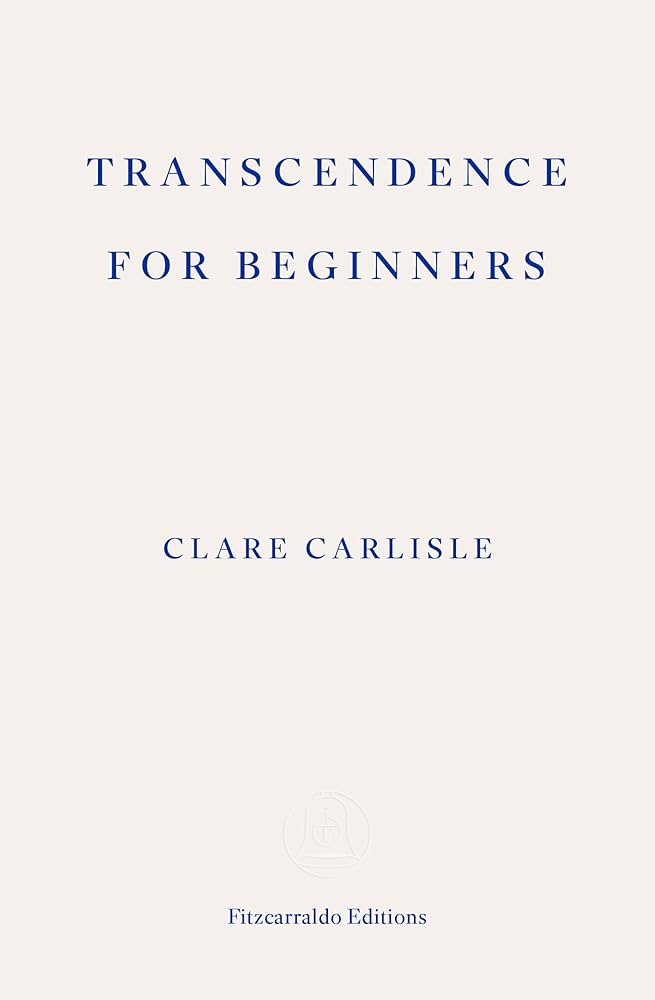
Clare Carlisle is a professor of philosophy. Her most recent book, Transcendence for Beginners, was published in 2025. I found it by reading a review/set of observations by glorious Sarah Bakewell.
I've read only a fifth of the book but it's worth reading slowly because there's value in nearly every sentence. Carlisle is obviously a thoughtful person who's put valuable words to a page; that sentence likely sounds pretentious but I read a lot of books and I seldom come across a writer as readworthy as Carlisle1. The following are some quotes from the book. They do not appear one-after-another in the book, by which I mean any eventual feelings of hyperkinesia are due to myself.
In his Ethics (1677) Spinoza called the ocean of substance 'God'. Everything that exists, he explained, is in God, and to know it truly is to know its being-in-God. Nothing is outside God or separate from God. We flow from and share in the divine nature, and whenever we act or perceive or think or feel, we are expressing its When Spinoza tried to specify our relation to God, these were the verbs he reached for: flowing, sharing (or participating) and expressing.
Spinoza was one of the first philosophers to argue that the Jewish and Christian scriptures are human artefacts, shaped by and for the imaginations of a particular community. Nineteenth-century thinkers would coin a new concept to name such a shared world: the 'milieu' or 'environment' - a dynamic ecosystem specific to a place and time that is simultaneously natural, social, intellectual and imagined. The milieu circumscribes the possibilities of what can take root, grow and flourish there. Though Spinoza focused on the Judeo-Christian milieu, his own native habitat, he would no doubt have made the same arguments about the sacred texts, teachings, songs, rituals and art of any other tradition.
For a Spinozist, to say that those traditions are human, and therefore natural, is not to deny that they also express and participate in the divine nature. They could be at once as natural and as divine as the rational and intuitive understanding which Spinoza privileged in the Ethics as the surest path to knowing and loving God.
But what about truth? If all our ideas, imaginings, works of art and religious teachings are equally natural, equally in God, does this mean they all have equal truth and value?
Spinoza argued that error consists in a lack of knowledge; more specifically, in mistaking a part for the whole. Imagine one of those anglepoise desk lamps, bent double to cast a small circle of light on the floor in a dark room.
We can see only what is illuminated by that single source of light - a patch of carpet, maybe. The funnel-shaped pose lampshade keeps most of the room in the dark. If we supthat nothing exists beyond this small circle of light, we are in error. If we know that we are in fact in a large room, and that when we open the shutters or switch on the ceiling light we will see its walls and furnishings, and notice a person sleeping on a couch in the corner who'll be awakened by the bright light, then we understand that patch of carpet for what it is: a part of a larger whole.
Spinoza titled his masterpiece Ethica because he thought the distinction between truth and error matters ethically as well as intellectually. In practice, we are always at least partly in error. Yet the circle of light may grow wider, bring into view more of nature, illuminate more connections between things, encompass a larger portion of the whole.
Doing philosophy means being devoted to this growth and expansion - this Spinozist transcendence. Crucially, the lines between truth and error are not static and readymade. They must not be drawn according to a doctrinal orthodoxy affirmed by a sacred text or a church, nor by a philosophical tradition - not even Spinozism - received as authoritative. When these orthodoxies funnel the light, they shape a milieu and guide a shared form of life. But they may be a cause of error if we take them to be circumscribing reality as a whole.
Studying the history of philosophy eventually supplied me with an ancient Greek concept, the kalon, which came closer to the sense of nobility I'd been reaching for. To kalon can be translated as 'what is noble', but also as 'the beautiful' or 'the fine'. For Plato this was a quality of phenomena, manifestations; it could be perceived either by our physical senses or with the eyes of our soul. The kalon is radiant, glowing, splendid. Its Form is seen 'shining in brightness', just as the Greek poets described their gods as luminous or sparkling. Plato's Socrates teaches that our souls knew the eternal, unchanging Forms before they were incarnated in these bodies - and perhaps we also recognize in some deep buried way this shining quality, which belongs to what is real and true. The kalon's radiance arouses our desire, brings joy and elicits praise. It can be discerned in bodies and objects, in virtuous actions and characters, or in a just political order. Aristotle argued that human happiness consists in living a life devoted to the kalon, which Hannah Arendt - the very first woman to give the Gifford Lectures - glossed as 'what is beautiful as opposed to what is necessary and useful'. Saint Paul famously confessed that 'I can will to kalon but I cannot do it.'
Whereas goodness, to agathon, is relative to specific ends and specific people - something can be good for one purpose and bad for another, or beneficial to one person and harmful to another the kalon simply is noble or beautiful or fine, to anyone with eyes to see it. It was not surprising that I'd felt puzzled by this notion of nobility; one classical scholar describes to kalon as an 'enigmatic good', another as an 'unmarked concept'. This conceptor something very close to it - shimmers into view right at the end of Spinoza's Ethics, where the difficult and elusive path to beatitude is summarized as omnia praeclara: all that is very bright, clear and luminous; very beautiful, splendid and noble.
The cave, meanwhile, evokes a primal scene of western philosophy. Plato, probably still the greatest storyteller in this tradition, described how Socrates asked his students to imagine they were prisoners trapped inside a dark underground cave, entranced by shadows on the wall. They devise games, competitions, tournaments, to see who is best at recognizing the shadows and predicting their movements. This cave is at once a shelter and a prison: an ambiguous symbol of the world, or of our own minds. Another time, Socrates's students were told to picture themselves swimming in murky waters at the bottom of the ocean. Both scenarios portray the philosopher's task as learning to breathe in the open air, in touch with what is real. On this view, philosophy is akin to certain strands of religious practice, and also to modern therapeutic techniques. It is oriented to ideals of awakening, enlightenment and liberation.
Not long after I returned from that first trip to India, I saw Jonathan Lear give a lecture on Plato's cave. He interpreted it as a sort of guided meditation that allows people to see and feel the distinction between how things appear and what they truly are. Socrates used this exercise to change his students' souls and reorder their desires - to convert them to philosophy, the pursuit of wisdom. And in a way, Lear's lecture helped convert me to philosophy. Plato's cave became vivid not simply as a familiar passage from a famous book, perhaps an analogy or a parable, but as an imaginative experience - and not a private, incommunicable experience, but one that might be transmitted and shared. This crystallized a question that was bothering me: what is the connection between philosophy and life? Pessimism about this question had made me disinclined to pursue an academic career. That day though, in the lecture hall, I swung towards optimism and decided to make an effort to get a job in a university. But the question still bothers me. Philosophy, the love of wisdom, is an ideal at once unarguable and radically open-ended - because we cannot assume we know what wisdom is, or how to acquire it; because what passes for wisdom, indeed for philosophy itself, might just be shadows on the wall.
-
For other examples of such writers, see the aforementioned Sarah Bakewell and also Verlyn Klinkenberg, Simone de Beauvoir, Joe Moran, and William Zinsser. ↩